National survey for the year 2013: Citizens of the Republic of Moldova support the e- Government Transformation reform

The Centre for Electronic Governance in collaboration with CBS-AXA carried out in November-December 2013 the second National Yearly Survey “Perception, assimilation and support by the population of the e-government transformation in Moldova”. The research carried out provides quantitative data, that have been collected from a representative sample (3021 people aged 18 and older), which comprised localities from all the districts of the country.
The results of the survey carried out during December 2013 show that 68% of the respondents support the implementation of the e-government transformation (giving marks from 3 to 6, on a scale of 1 to 6 for their level of supporting the reform), thus registering an increase by 10% of this ratio, as compared to the situation in 2012.
Comparative estimations regarding the level of supporting the e-Governance Transformation, %
Fully support 50/50 Do not support DK/DA
We can notice an increase of the degree of information. It this context, the ratio of those who did not answer this question decreased from 22% in 2012 to 13% within this very survey.
54% of the respondents know the benefits of the e-Governance, while 15% of the respondents do not see any benefits, and 32% of the respondents cannot answer such question.
20% of the respondents believe that the main benefit provided by the e-Governance is the possibility to save time; 14 % enjoy the opportunity to get fast services, while 11% claim that free access to information is the main advantage provided by the e-Transformation process.
We also registered a positive dynamics in the level of people openness toward using online public services. In 2013 the percentage of those who expressed their willingness to use online public services by means of a computer and/or a mobile phone reached 65% (the ratio of the respondents who gave marks from 3 to 6 on a scale of 1 to 6).
Estimations of the willingness to use online services, %
By means of a mobile phone
By means of a computer
DK/DA don’t want willing a lot
The estimations noticed within the respective survey in the context of the respondents’ willingness are higher than the ones provided by the respondents during the previous survey.
The average comparative mark of the respondents’ willingness to use online services
The willingness to access electronic services by means of a computer as well as of a mobile phone is higher in youth having higher incomes, managers of all the levels, highly qualified specialists, and high educated people, pupils/students, and citizens of the capital city.
By means of a mobile phone
By means of a computer
Citizens of Chisinau choose to use rather a computer in order to access electronic public services, while people from the rural area, as well as the respondents from the North part of the country prefer to use the mobile phone in this respect.
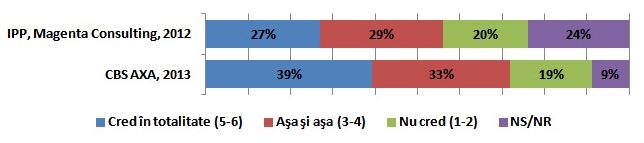
Citizens’ level of trust in the online public services quality corresponding to the respondents’ expectances registered an increase in 2013, as compared to the previous year. Approximately 72% of the respondents in 2013 gave marks from 3 to 6, while in 2012 their ratio constituted 56%. The level of uncertainty decreased. Only 9% of the respondents did not want to/ did not know to estimate the given issue, as compared to 24% of respondents in 2012.
Comparative estimations regarding the level of trust in the online public services quality corresponding to the respondents’ expectancies, %
Fully believe 50/50 Do not believe DK/DA
At the same time, citizens’ level of trust in ensuring protection of personal data within the providing of electronic public services is still low enough, registering an average of 2.8 on a scale of 1 (don’t trust) to 6 (fully trust).
The ratio of the respondents who gave marks from 3-4 and 5-6 was 41%.
The analytical report with the survey results on all the paths can be found here.
 RESULTS_SONDAJ_EN.pdf (4.38 MB)


