
The use of electronic public services is increasing every year [3]
Moldova is gradually becoming digitized, and its citizens are beginning to better understand the significant benefits of e-governance and to widely use technologies in their interaction with the state.
The results of the 2020 National Annual Survey reflect the public opinion about the transformation of government services most directly and provide relevant data on citizens' perception, uptake and support for e-Governance and modernization of public services.
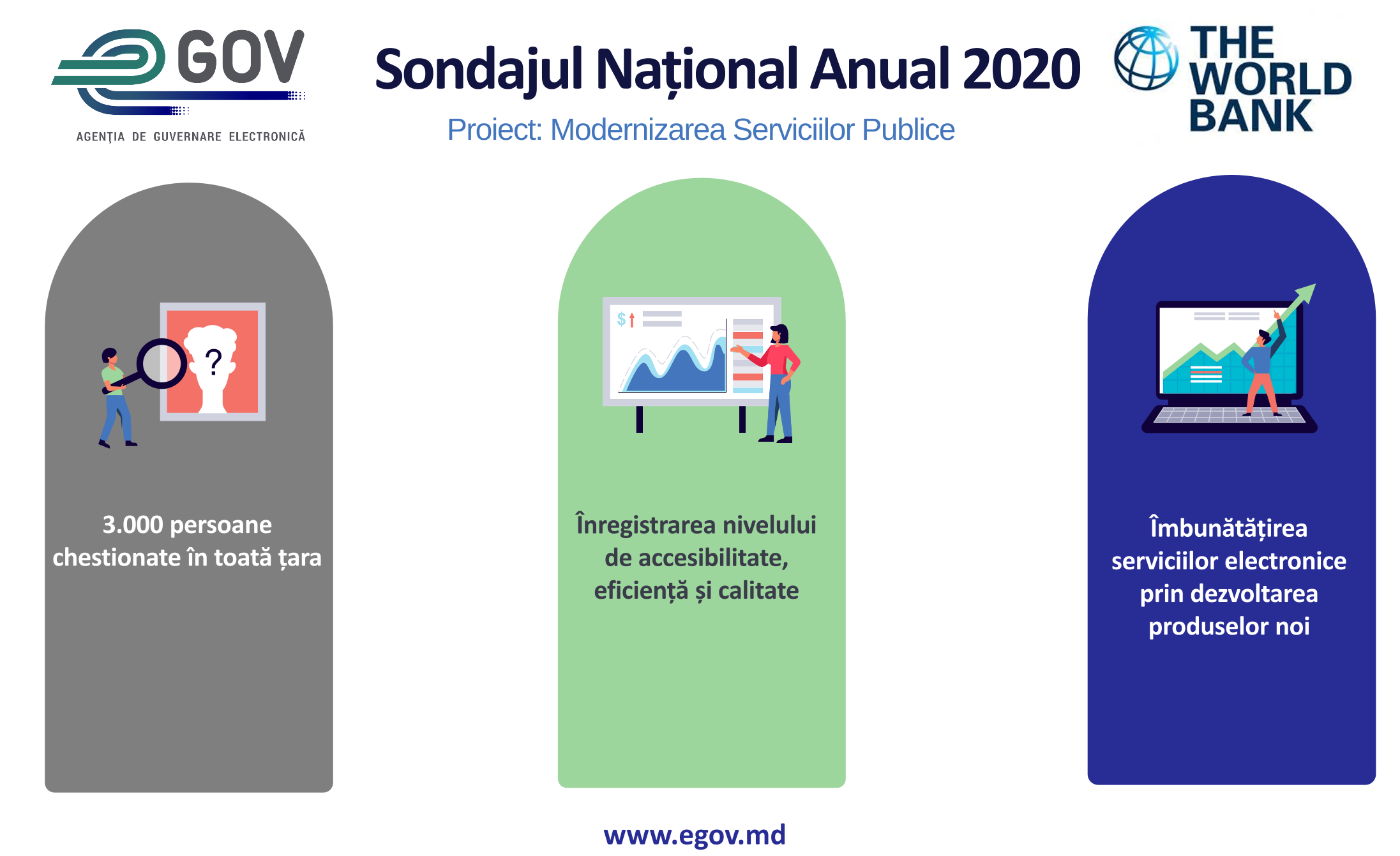
The survey focused on 3 key indicators of the Modernization of Public Services Project: accessibility, efficiency and quality and aimed at collecting data on the level of knowledge and use of e-government platforms by citizens, as well as their trust in online public services provided by state institutions.
Relevant indicators highlighted by the questionnaire include the growing number of people who say they are willing and open to use electronic services, their share increasing considerably compared to 2016. When asked what they would choose between the two ways of accessing a service - online or offline, more than half of respondents say they would choose to access the public service online. This indicator could be influenced by the pandemic that marked the year 2020.
The survey results also show that 62.6% of the population are convinced that the citizens would benefit from the implementation of e-Governance – the reduced number of visits needed to obtain the service and elimination of corruption were mentioned as the main benefits expected by citizens following the Modernization of Government Services reform. Over two-thirds of respondents expect benefits from the implementation of e-Governance Transformation. Young people with an advanced education degree, those who have a computer and internet at home mentioned these benefits at a higher rate.
In terms of the quality, most respondents rated the quality of electronic services with maximum or average grades - about 60% gave grades from 4 to 6 (on a scale from 1 to 6).
According to the survey, the level of digital literacy, the skills in operating electronic devices and surfing the Internet determine the preferences in the use of electronic services. Currently, 37.3% of citizens can be categorized as independent users of electronic services, other 36.0% would need support from other people and only 22.4% of respondents need considerable support, preferring to fully delegate the task of accessing and obtaining the service to another person. The latter category includes the elderly, residents of rural areas or those with modest incomes.
As for the use of government electronic platforms, a substantial increase has been recorded in the 8 years of tracking this indicator (3 times higher than in 2012, according to the latest survey). The share of people who have accessed electronic public services is 32%. The most frequent users are young people aged between 18 and 29 years.
In the top of most frequently accessed services in 2020, the respondents mentioned electronic tax services, electronic cadastral services, criminal record, documentation services (PSA) and e-CNAS.
Most electronic public services are still accessed mainly through the web pages of the relevant institutions, to the detriment of the Public Services Portal. About half of the services were accessed mainly on the computer, and the other half on the mobile phone. All trends suggest that in the future the rate of use of services using the smartphone will be constantly increasing.
The survey was conducted between 7 and 21 November 2020 by the CBS Research Centre of Sociological Investigations, commissioned by EGA within the Modernization of Government Services Project, implemented with the support of the World Bank Group. More than 3,000 people from 13 regions were covered by the survey. This sample is considered representative for the Republic of Moldova, allowing to obtain comprehensive data on how the citizens understand and use the electronic platforms. These data are important and useful for the continuous improvement of the quality of governance and the modernization of public services.
The results of the 2020 survey must be interpreted taking into account the impact of the COVID-19 pandemic on citizens' perceptions and behaviour. The pandemic and the containment measures put in place in 2020 left their mark on all areas of social life, including on how the public services are accessed and on the needs in using public services.